Talks 01
Mirza
Čizmić
On Bosnia as an inner space, on fear that has become normal, and on a yard in Banja Luka that is, he says, a utopia precisely because everyone has to leave it.
About the artist
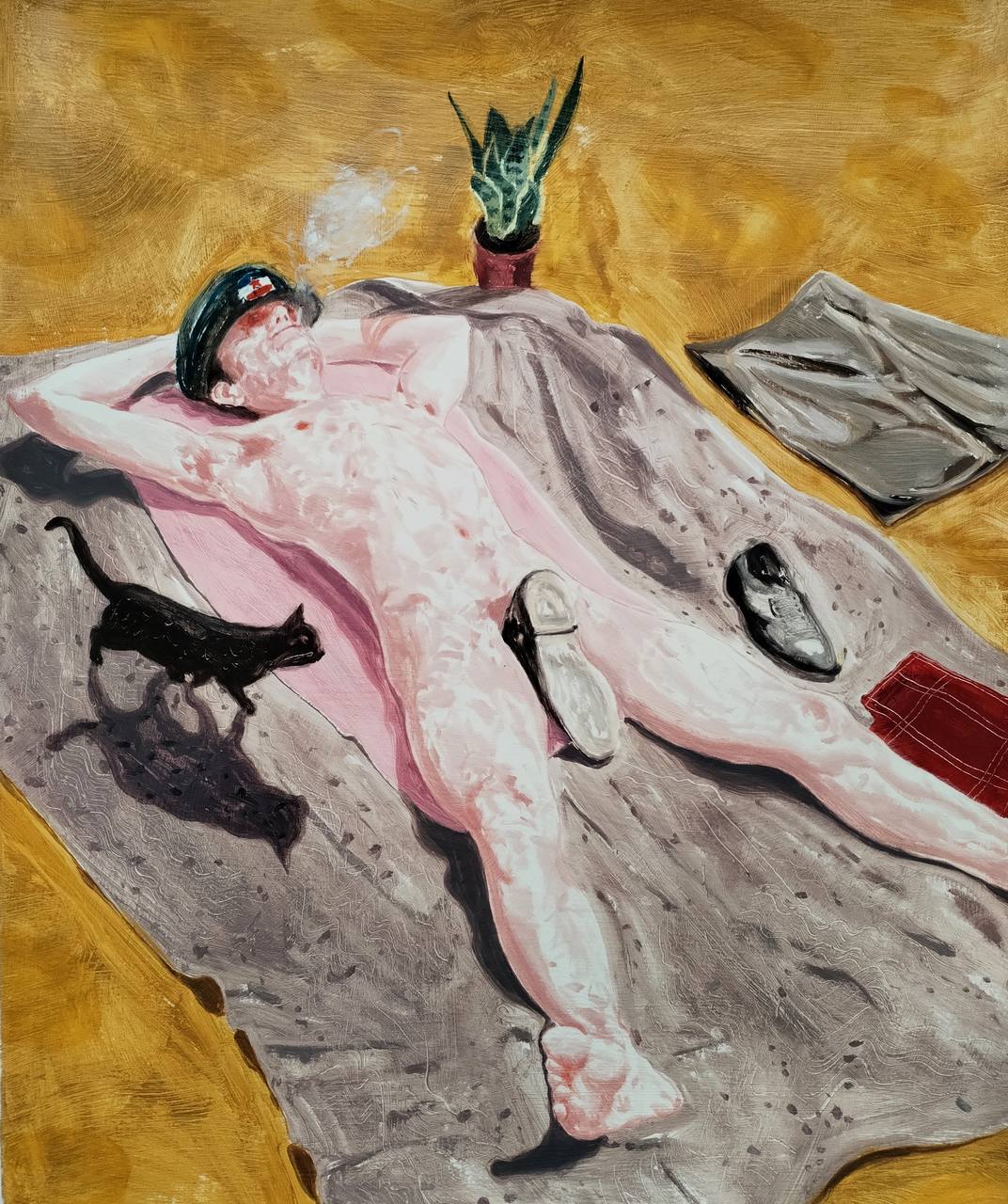
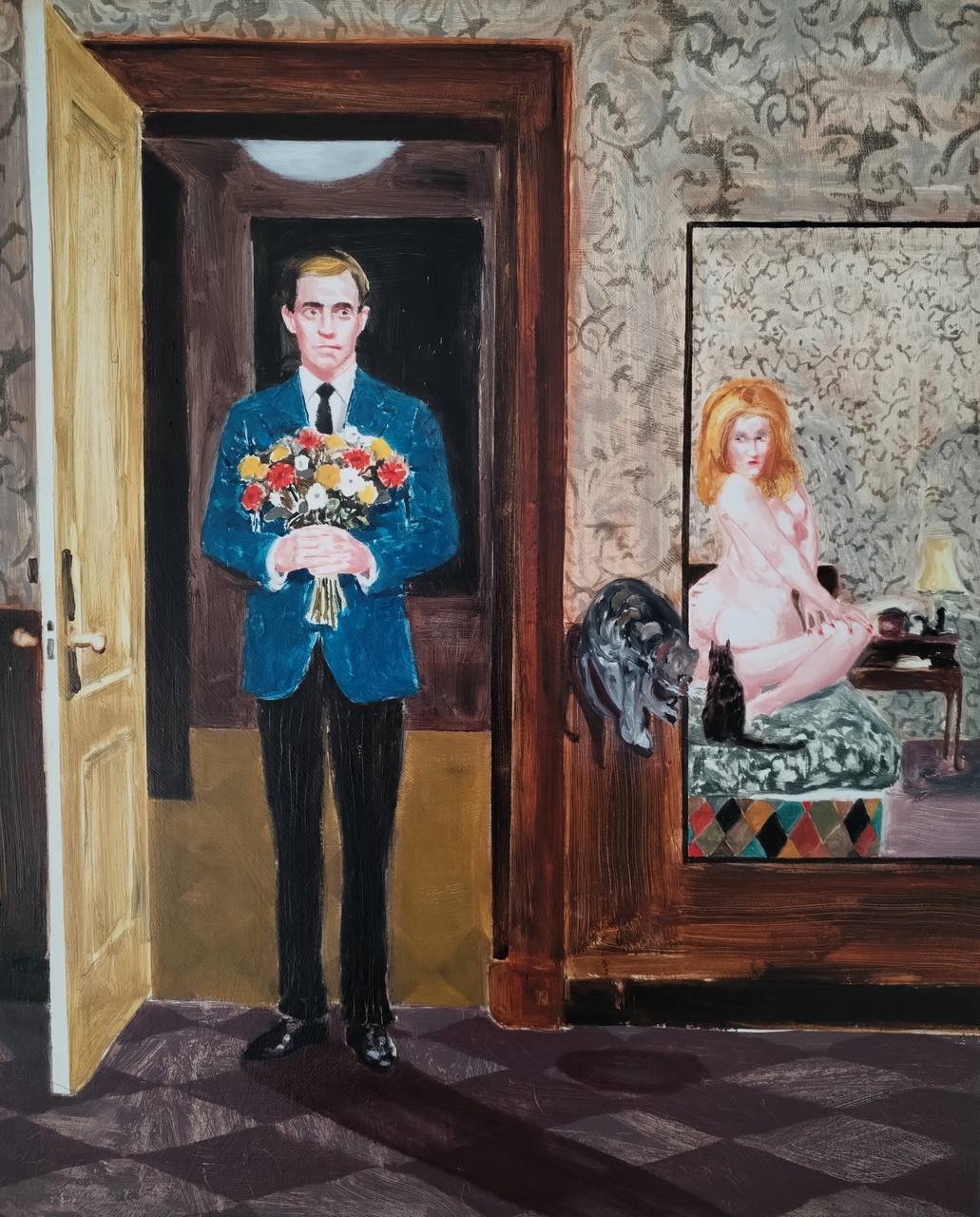
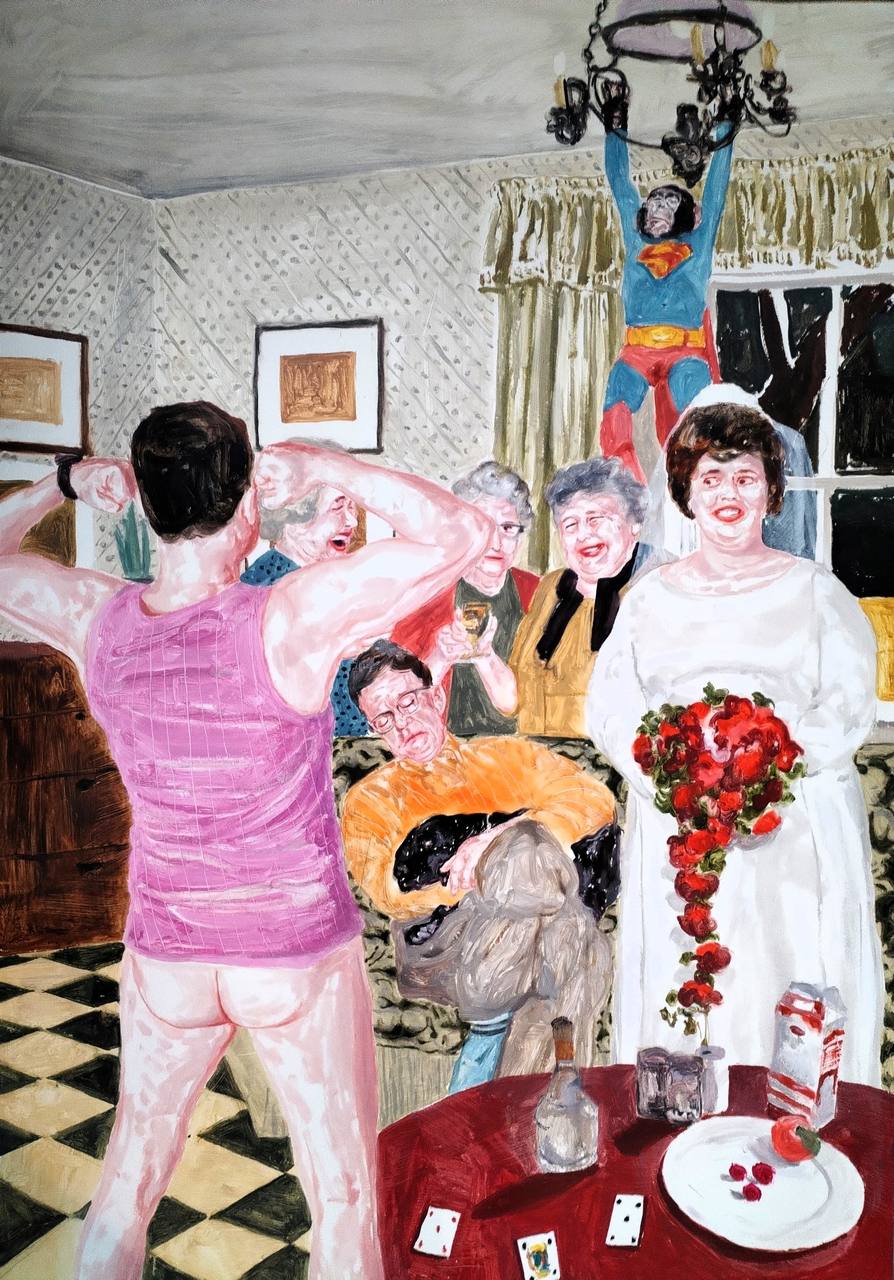
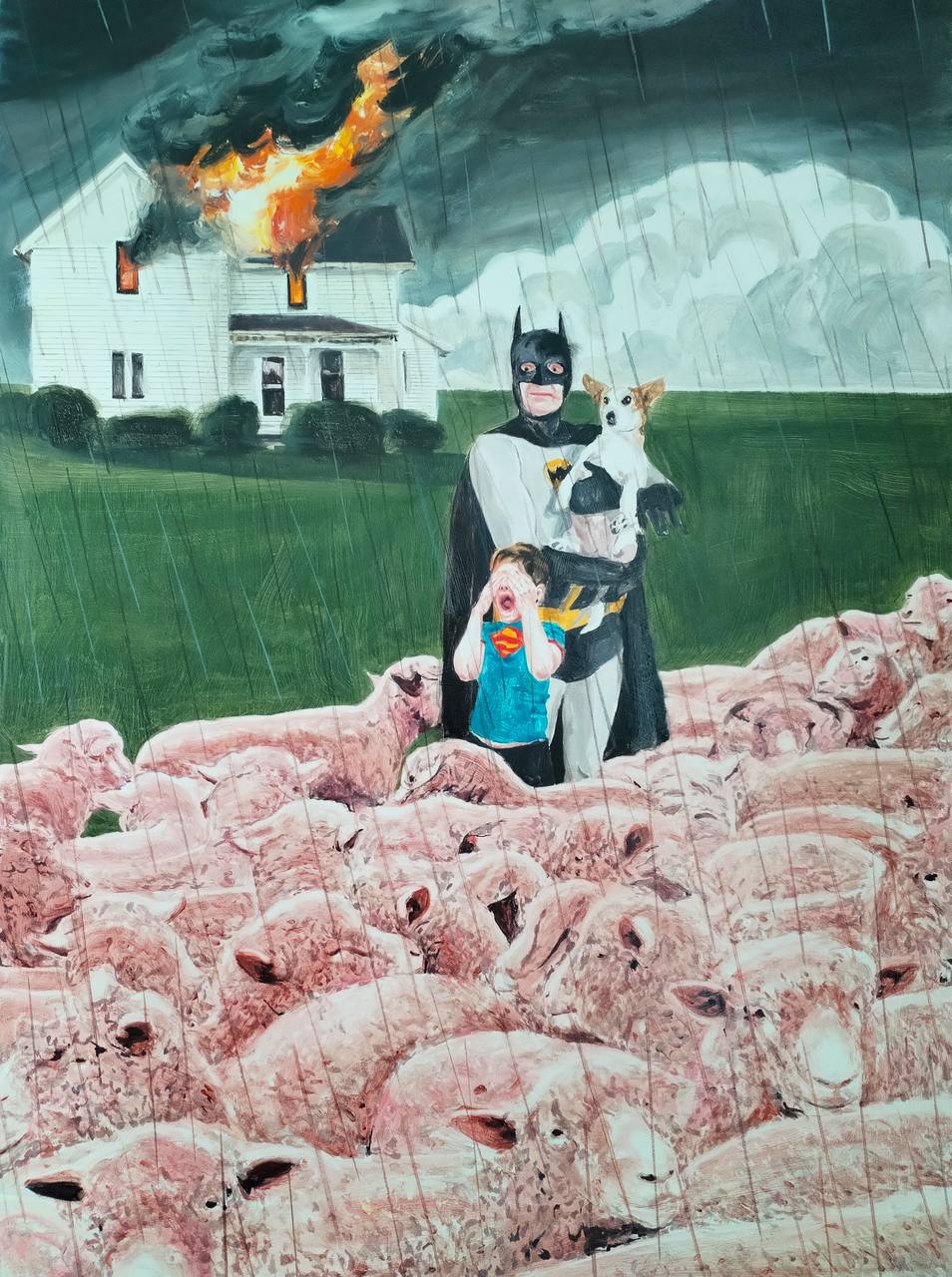
Mirza Čizmić's paintings look like family photographs that someone has misremembered. A wedding, a birthday, a bathroom, a back yard — scenes familiar from albums of the seventies and eighties, except that a man in a Batman costume holds a dog while a house burns behind him, a monkey dressed as Superman hangs from the chandelier, and black cats slip through the frame like silent witnesses. In Čizmić's work absurdity is not an addition to the picture but its foundation: nostalgia is not depicted, it is undermined.
The figures come from real people, memories and experiences; the spaces he places them in are mostly invented. That gap produces the tension of his compositions — the recognisable warmth of a domestic scene and the unease that refuses to stay hidden beneath it.
Born in 1985, Čizmić completed the School of Applied Arts in Sarajevo and an MFA in painting at the Academy of Fine Arts in Helsinki, where he still lives and works. He works across painting, sculpture, performance and film, and his works are held in the collections of the Kiasma Museum of Contemporary Art and the Finnish National Gallery. He has worked with Brodac since 2020, when he took part in the Art In Isolation programme; in 2026 he exhibited with the Contemporary Bosnia platform at the 9th edition of Art Fair Nesvrstani in Zagreb.
Where are you today, literally and a little less literally?
When you look at the place you live in now, the people around you and your own everyday life — what seems to have changed most in the last few years in the way you see the world?
Literally, I am where I most want to be — within my family. I'm surrounded by dear people who fulfil me and give me energy, in exactly the measure that does me good.
What has changed in the last few years? My way of approaching the environment around me. I'd say that today I am much better able to recognise where I want to be and where I need to start from.
How far does a person really get from the place they come from?
You live and work in Helsinki, while Sarajevo, Bosnia, family and images of another time stay present in your work in different ways. What of that place is still real to you today, and what exists as a version you have built over the years in your own memory?
Bosnia is my home, my starting point. Bosnia is woven into me — not as a system, a state, or everything Bosnia and Herzegovina stands for today, but as a climate, a region. As a place that is a kind of nursery of healthy, strong and emotional people who are, unfortunately, often trapped in the cages of their own — I would say — warped beliefs.
Elements of nostalgia are evident in my work, but I don't try to show nostalgia directly. I show it more through the absurdity of different situations, through relationships between people, and through what remained somewhere between real experience and memory.
They say childhood is the true parent of every person. My childhood was never tied so much to places as to people. That is why the spaces in my paintings are often invented, while the figures are real — drawn from real people, memories and experiences, but placed in entirely different contexts.
I don't think a person ever fully escapes the place they come from. You can change city, country, language and way of life, but what is woven into you stays. That is why Bosnia appears in my work not as a geographical place, but rather as an inner space I carry with me.
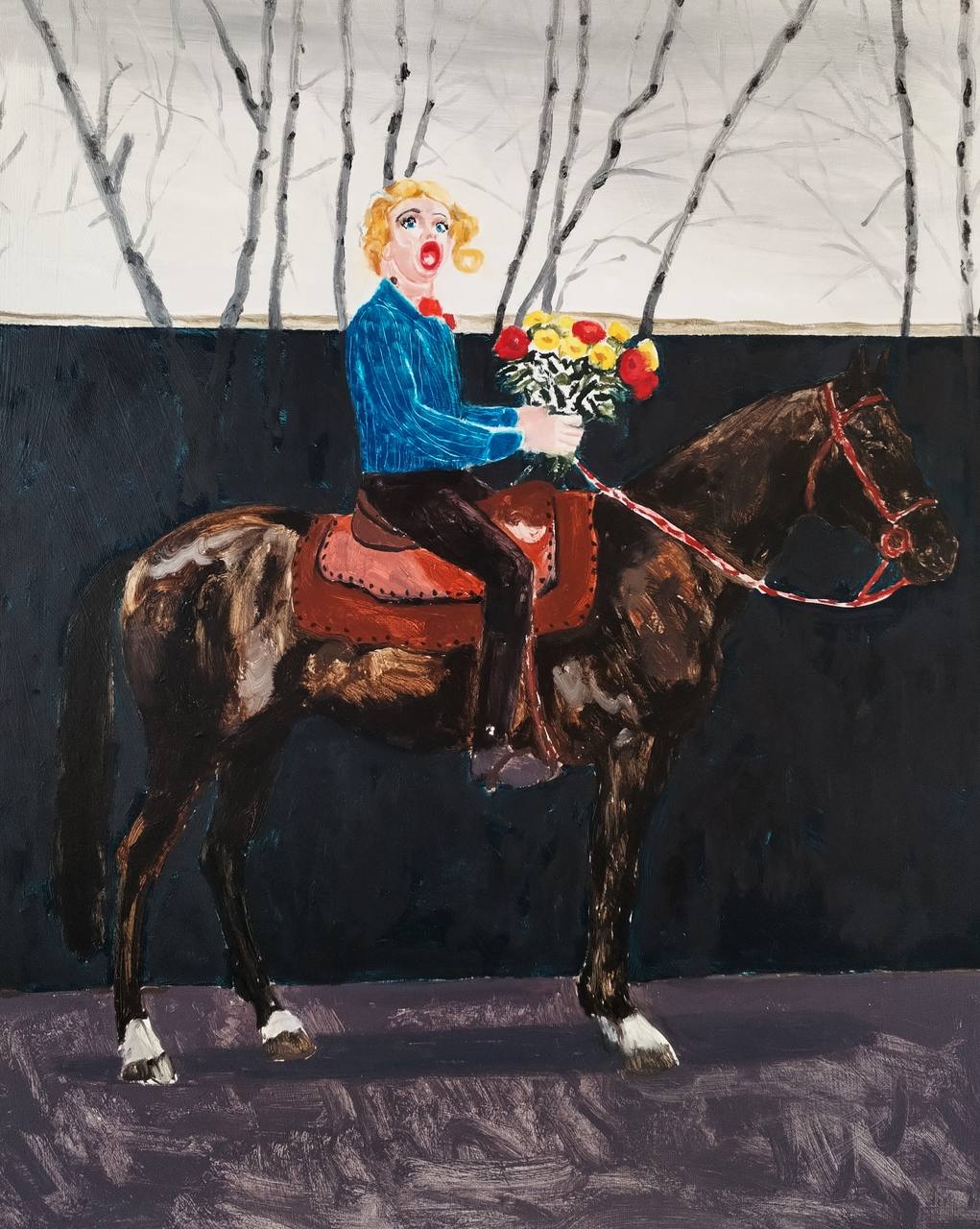
What is normal to you today that would have seemed completely absurd ten years ago?
Not necessarily in art — in family, work, relationships, society, or the way we spend our days. Where do you notice that quiet absurdity of the everyday most?
Today it is normal to be afraid. Today it is normal for free speech to be sanctioned. Today it is normal to hate the other. It is normal to be cruel, to be inhumane, to stay silent, to hide, to mock others. It is normal to lie, to be dishonest!
Ten years ago I might have seen all of this as exceptions. Today I have the feeling that the exceptions have become the rule, and that what should be abnormal is more and more often presented as entirely ordinary. The greatest absurdity is precisely that we have got used to all of it.
And perhaps that is the most dangerous thing of our time! Not that bad things happen, but that we have started living with them as if they were normal. When fear becomes normal, silence becomes normal, injustice becomes normal, we no longer notice how far we have drifted from what ought to be human.
That is probably why we are where we are.
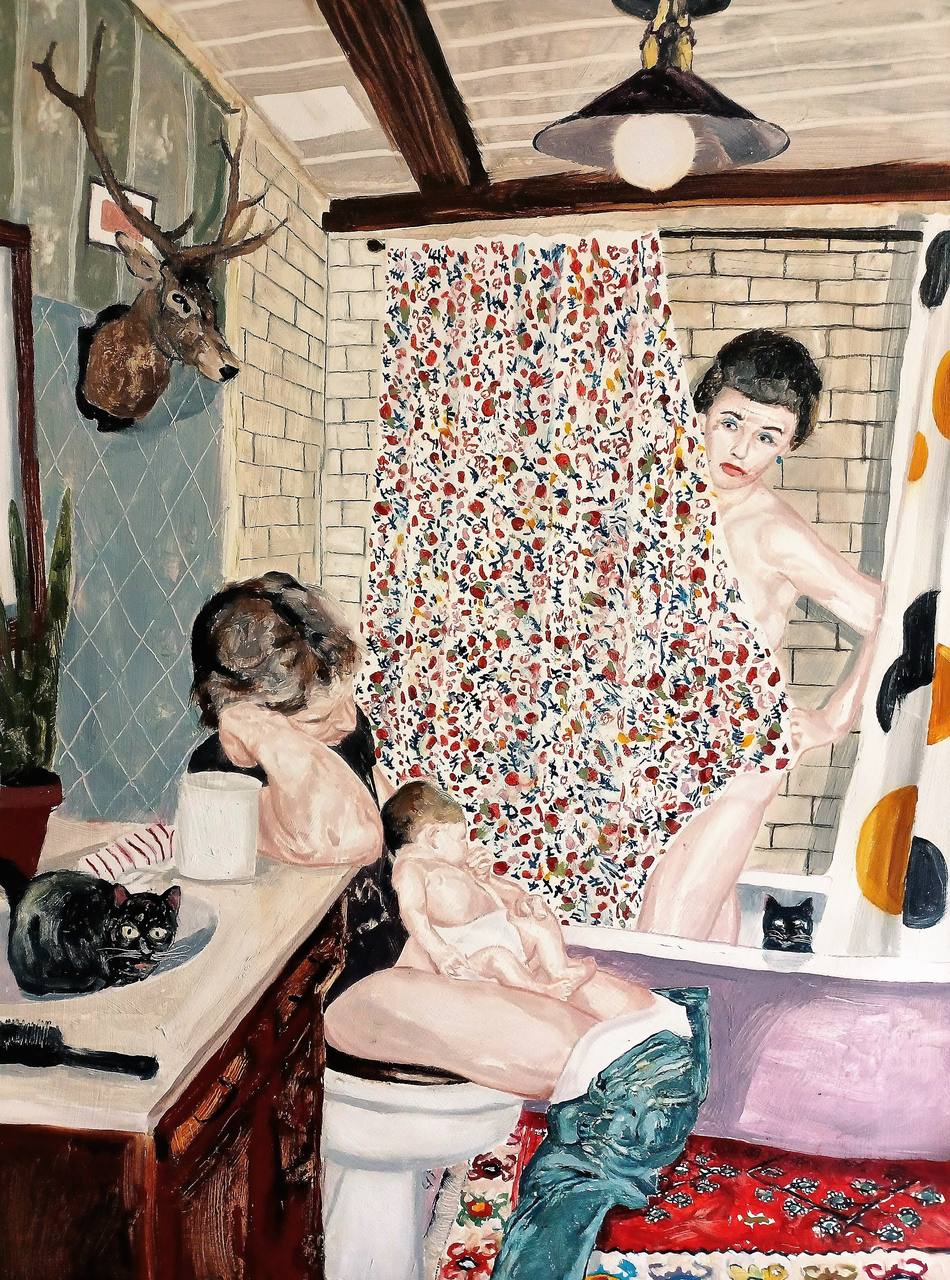
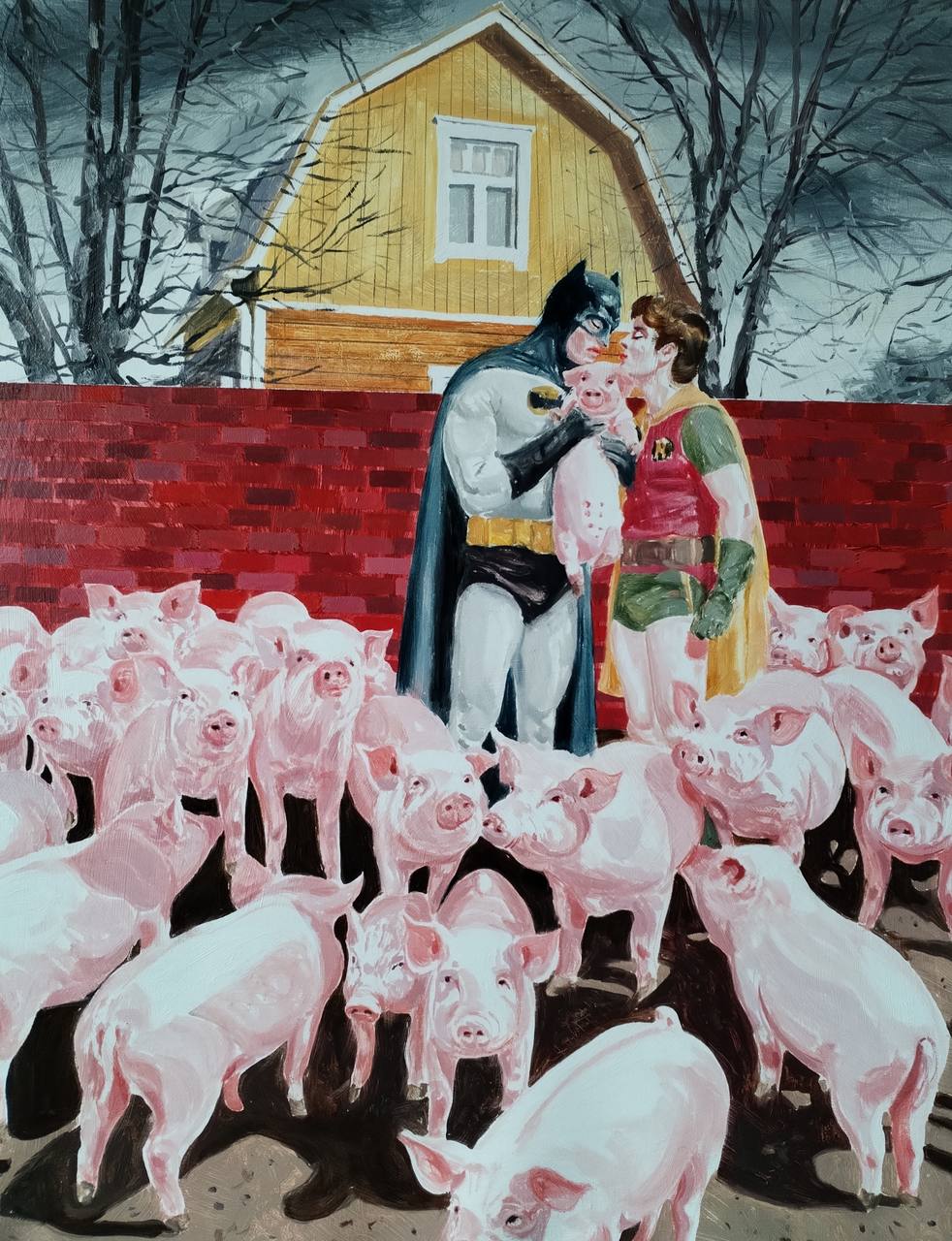
Is there something from your private life that keeps trying to become a painting, and you still won't let it?
Where do you draw the line today between what belongs to Mirza the person and what can become material for Mirza the artist?
There is Mirza and there is Mirza Čizmić.
Mirza is a father, a husband, a son, a brother and a friend. He is a man trying to tend the life he has built, to look after the people he loves, and to live so that his life endangers no one. That part of me has a right to privacy, and not everything I live through has to become art.
Then there is Mirza Čizmić, the artist. He is far more restless. He watches people and the surroundings he lives in; he recognises absurdities, contradictions, fears, desires and relationships that often go unspoken. What Mirza may notice, Mirza Čizmić tries to translate into a painting.
So I don't think the line between private life and art is entirely solid. It exists, but it is permeable. My life feeds my work, but my work doesn't have to eat my life.
I think that is what matters most to me today. I don't want to make art out of everything that happens to me. I want to have a life that exists outside art as well. And then, when something from that life stays in me long enough — when it starts to nag at me and asks for an answer — that is when I may translate it into a work.
“My life feeds my work, but my work doesn't have to eat my life.”— Mirza Čizmić
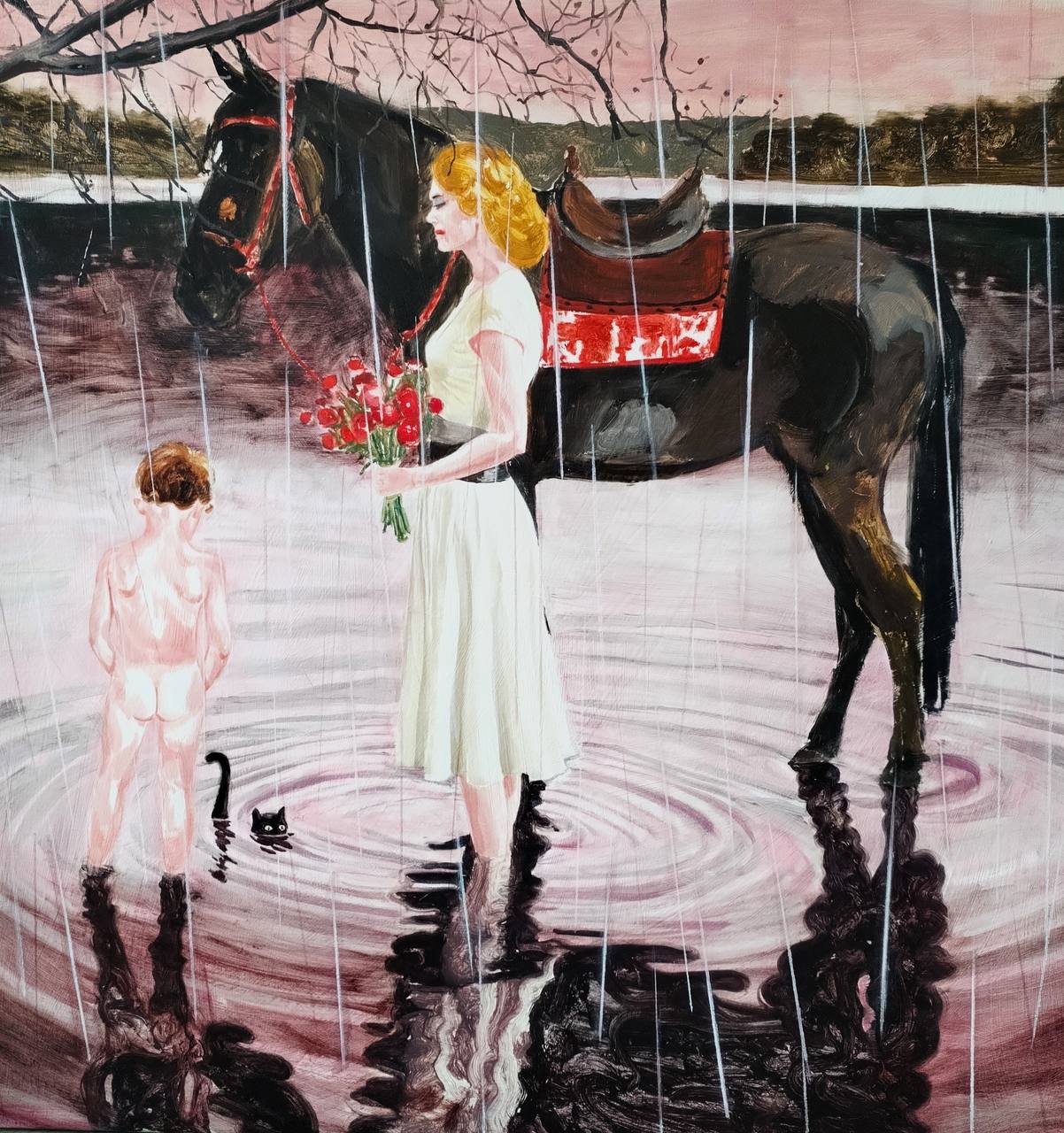
If you had to keep just one completely ordinary image of life today — what would be in it?
Not a work of art, but a single scene we will return to in twenty years.
In that image would be my yard in Banja Luka, full of people dear to me. We're drinking coffee, eating watermelon, talking, and we are all together. Nothing special is happening. That is exactly why I would want to keep that scene.
We are all there, but we know that tomorrow everyone has to head back — to another country, to the city where our everyday life takes place. That is why the yard, for me, is not just a place. It is a kind of utopia.
That one image would hold what we have perhaps missed most: being all in the same place, at the same time, with no need to hurry anywhere and no awareness that in a few hours we will part again. In twenty years I may not remember what I said that day, but I believe I will remember the feeling that, if only for a moment, we were all there.
The yard is a utopia precisely because we know we can't all stay in it.