An independent gallery in Sarajevo
For a hundred years this building was in the business of keeping people in. Municipal, then a prison, with cells on the upper floors and catacombs under the stable — architecture in which time was measured by how long you did not get out.
The gallery moved into the ground floor in 2016. None of it felt symbolic while it was being done — the symbolism turned up later, when it became clear that a space built for confinement takes rather well to the opposite.
Contemporary Art Gallery Brodac was established in 2016, as an enthusiastic effort of several volunteers willing to fight against social-economic and political oppression and youth indifference. A group of young artists organized “working actions” to clean and create space where they can exhibit and share space with their colleagues, since the government nor others were willing to take care about the rising art our young generation has to offer.
Our primary mission is to promote and enhance contemporary art scene, in the country and abroad, which will be real contribution to positive changes in society. We are ready to improve the life-quality of our citizens by bringing up the most important thing for their personal and common growth: culture. Art is foremost a useful and necessary tool in fighting illiteracy and the strongest advocate of people. An artist is a worker constantly representing all workers who work for living — earning fairly through the creation process — producing the product for good of all.
By creating and giving opportunities for artists and audience to interact in an independent space, excluded from any unwanted political or social impact — surrounded only by quality art-works, we will improve both: the life-standard of citizens by being a conduit toward the public, as well as continuing the process of de-marginalizing culture in order to make our contemporary art scene stronger and bigger — as it deserves to be.
Since then there have been 82 exhibitions and 88 artists here. The gallery has no standing funding and no staff, and every install remains a separate decision to do something without cover.
Brodac is first of all a non-profit space. The gallery is funded from its own means and occasional support, admission is not charged, and no exhibition is chosen because it will bring something in.
The programme is not split into established and emerging. In the same season you will find artists with thirty years of work behind them and artists having their first solo show — on the same terms, in the same room, on the same walls. That balance is the only decision the gallery makes in advance; everything else is decided by the work, not the biography.
Which is why this site never says who is emerging and who is established. It says what each of them showed and when, and whose first solo exhibition happened here. The reader draws the rest.
“Ventures like this are the necessary answer — first of all, to make a space for ourselves.”
Mak Hubjer
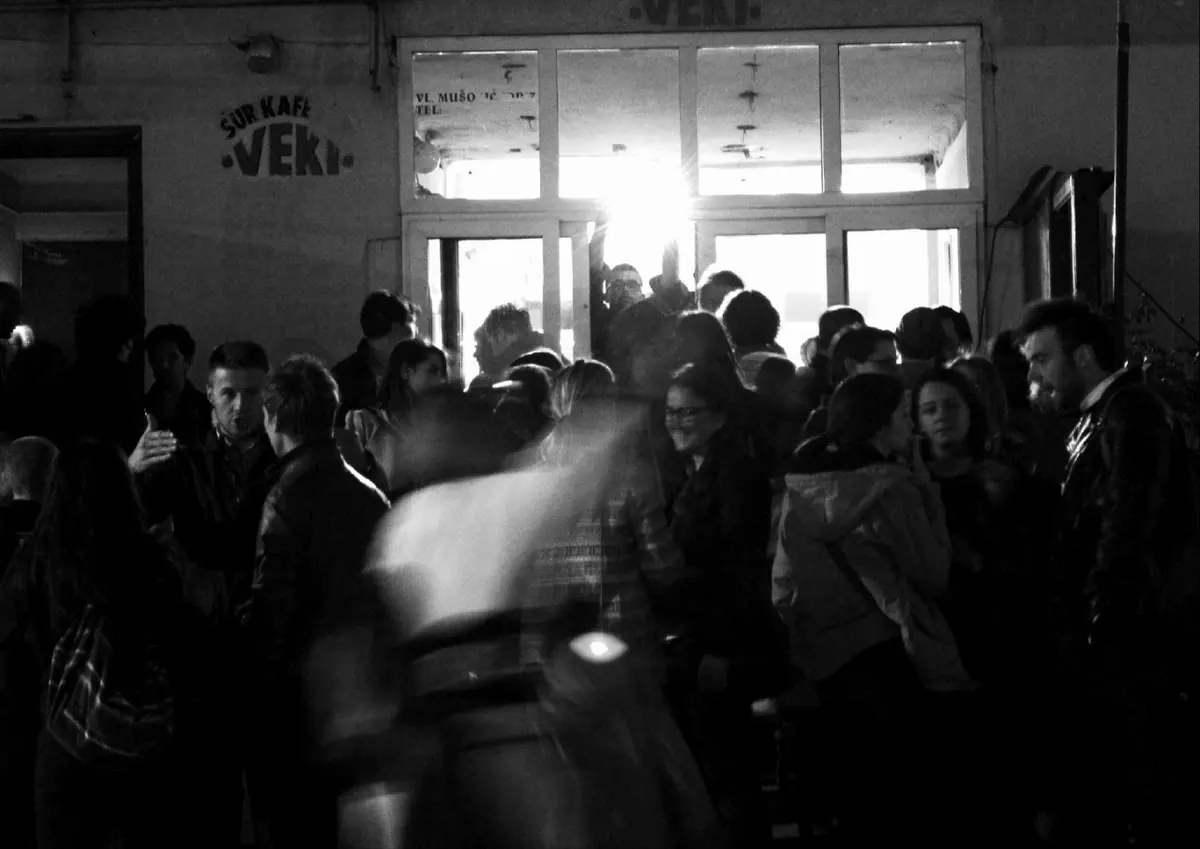
Until 2016 a café ran on the ground floor. Its sign is still on the wall.
Old Town Sessions
A music and residency programme with Klabika: live sessions recorded in the gallery and streamed online. More than 20 musicians from 10 countries have taken part, from Vienna to Santiago de Chile. The gallery space is used for something other than an exhibition.
Books for Brodac
An open call for people to donate books on art and architecture. The City Hall is across the street; more than two million books burned there in 1992. The library in the gallery is a small answer to that.
Kuma International
A summer school on contemporary art and memory, first held in 2018. The group exhibition ReMemory 1992—2022 came out of that collaboration.

The gallery mark and the Project 7 mark
Project 7 is the programme platform started in 2026. The gallery reopened under it in February, after a four-year pause. The platform runs the exhibition programme, builds an archive of works in analogue and digital form, and works on regional exchange. Art director: Elmedina Imamović.
Mak Hubjer
Visual and performative artist (1993), born and raised in Sarajevo, now based in Zagreb. Graduated from the Academy of Fine Arts in Sarajevo and holds a master's in painting from the Art Academy in Split. His work deals with public space, memory and monuments — interventions that dismantle, reveal or revive the links between monuments and collective memory. His work is held in the Eur'Art and Duplex100m2 collections. He founded Gallery Brodac in 2016 and has run its programme since.