Talks 02
Maja
Ružnić
On home as a feeling rather than a place, on memories that work like stains, and on painting as the one space where she still allows herself not to know.
About the artist
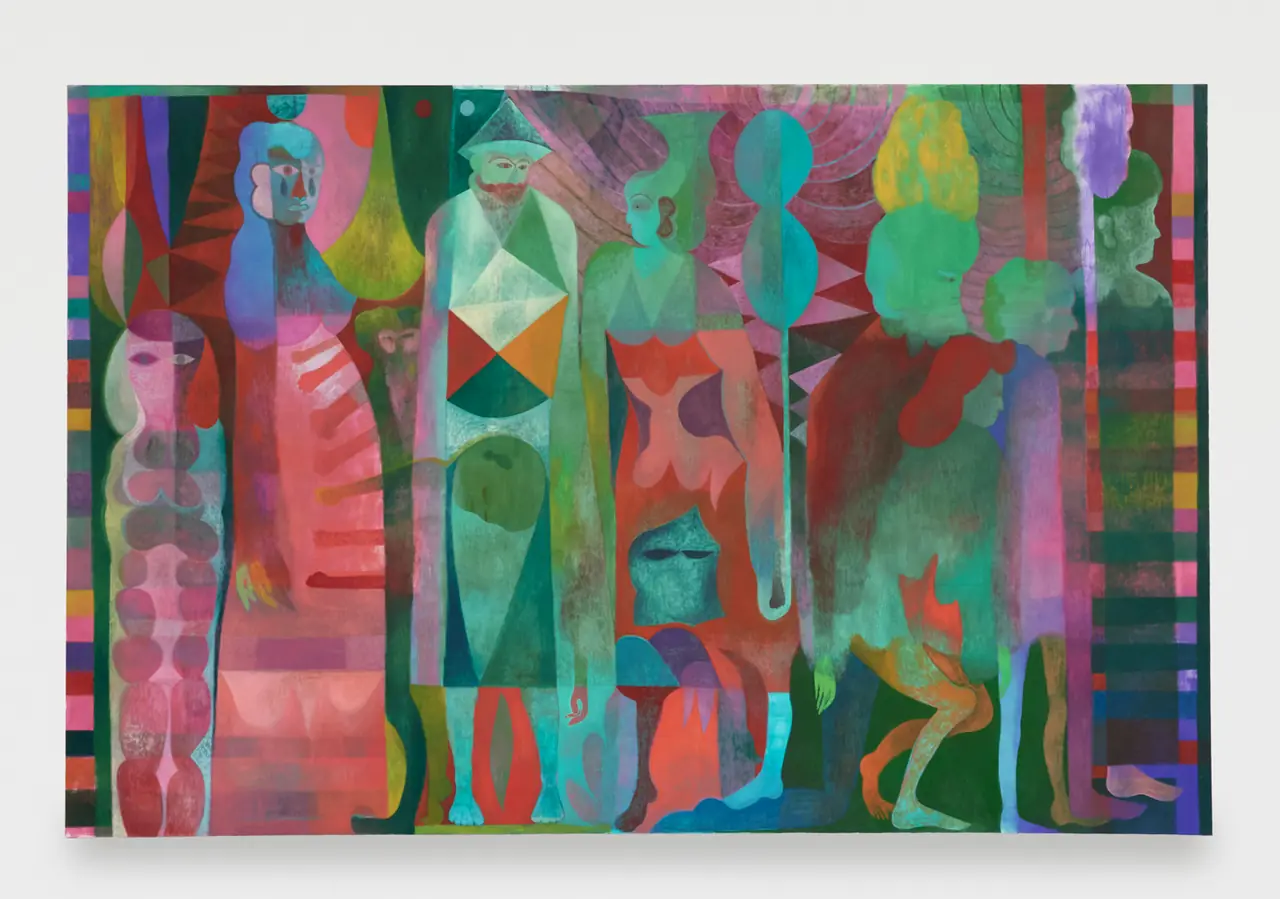
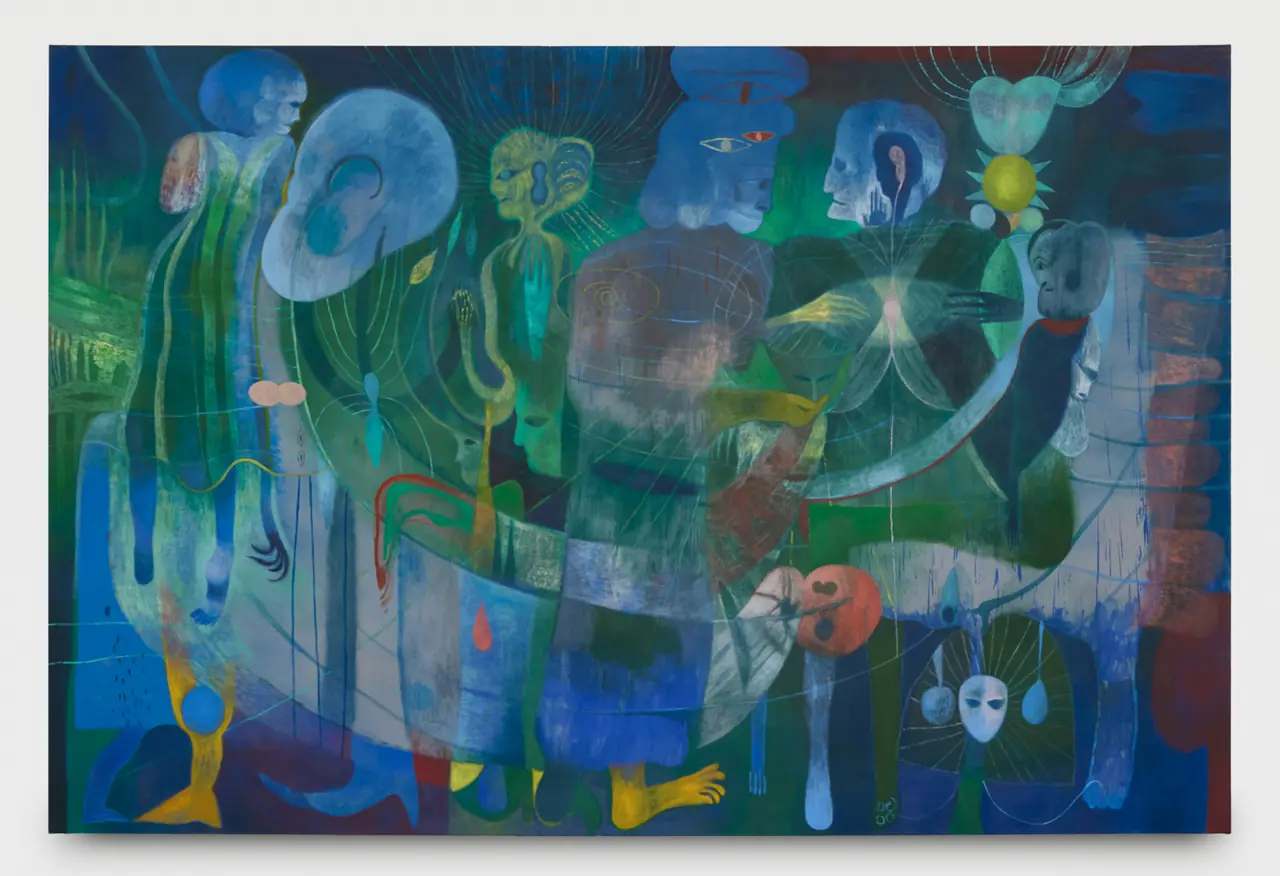
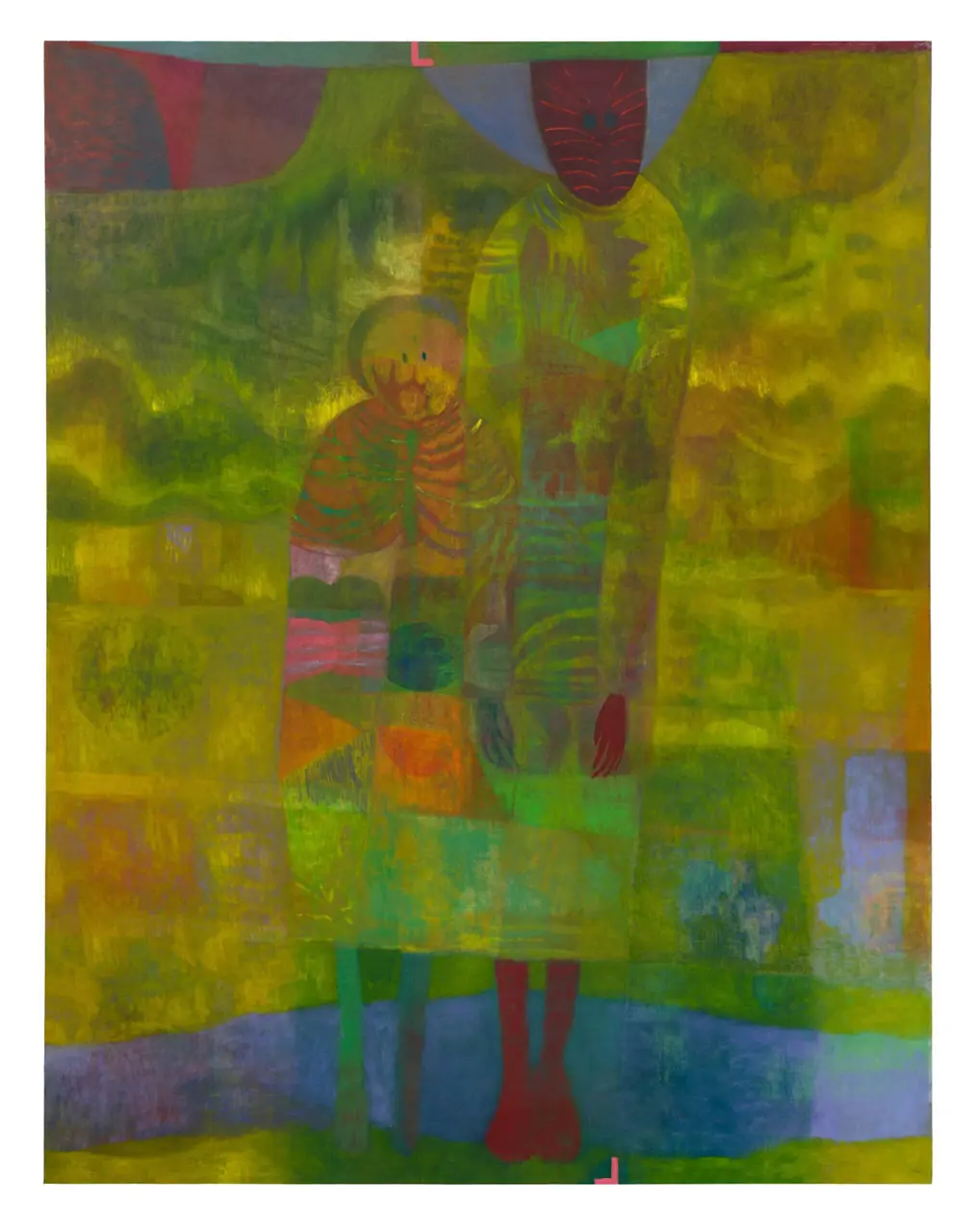
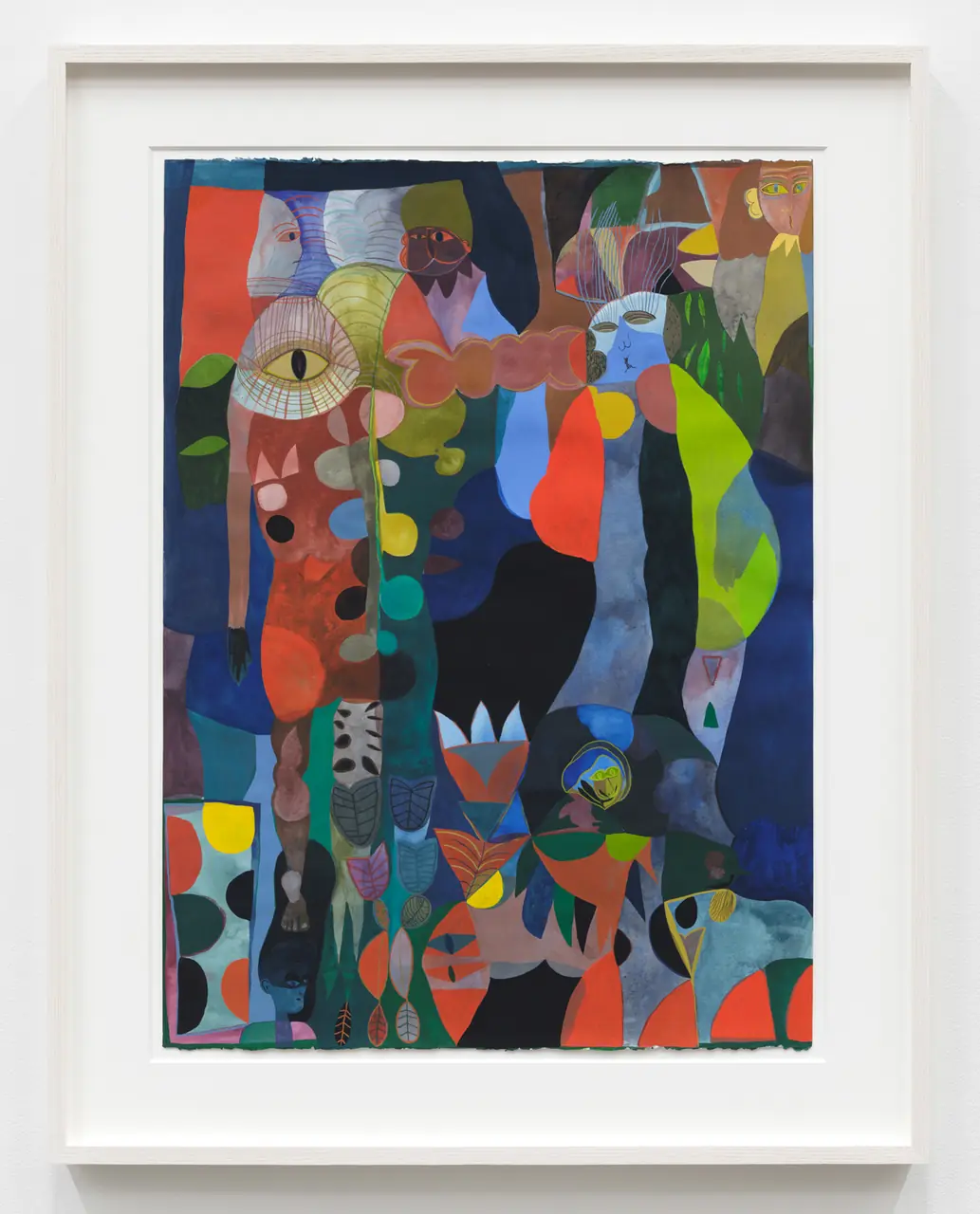
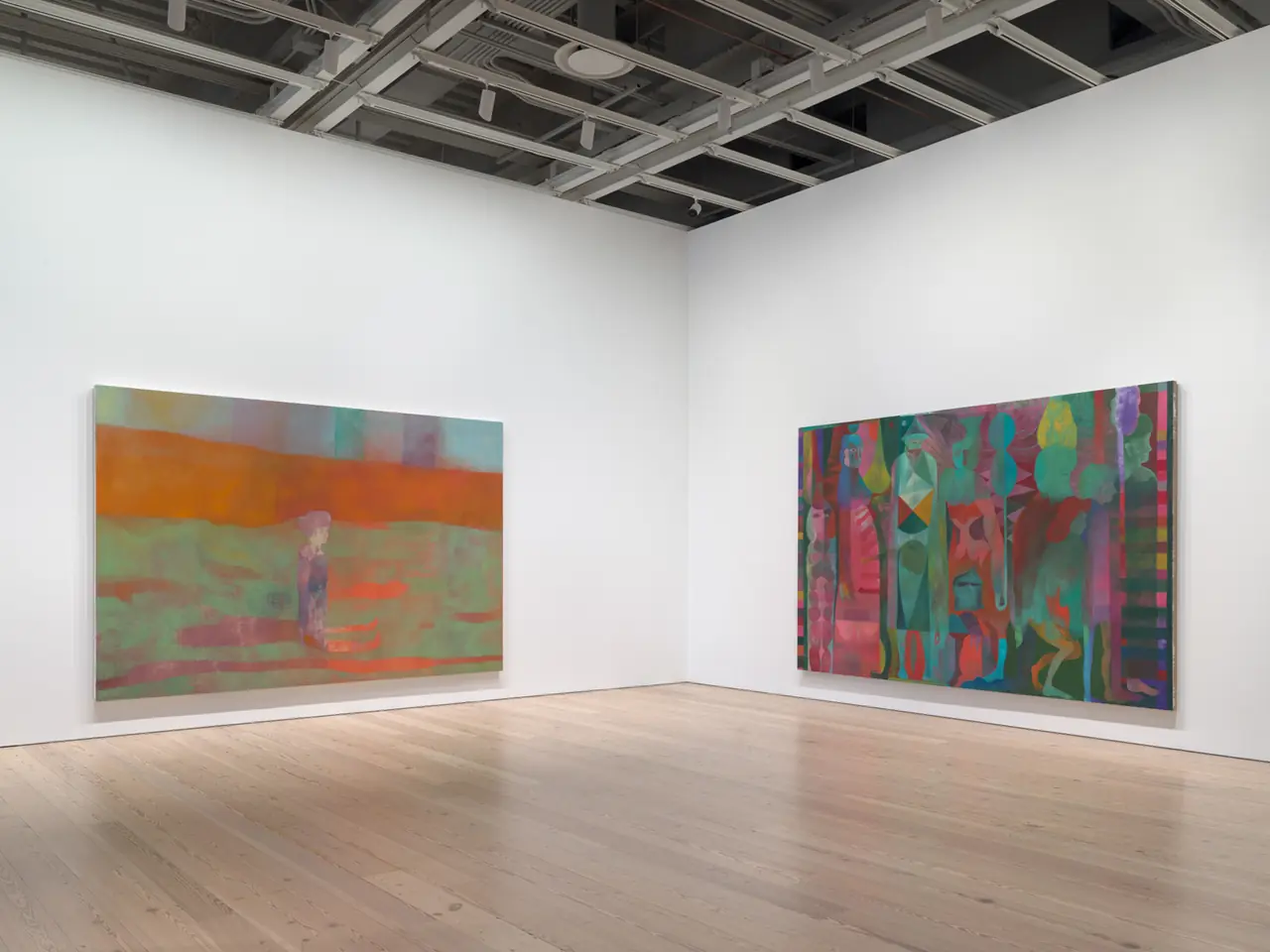
Maja Ružnić’s paintings are built in layers of diluted pigment, without a sketch and without a predetermined destination. Figures are not drawn so much as surfaced — out of fields of colour, out of stains, out of whatever appears once the canvas has been turned enough times. What remains sits somewhere between portrait and landscape: processions, couples, mothers with children, faces looking through a sheet of green or blue as if through water.
The method draws on an equally layered set of sources — Slavic folklore and shamanism, alchemy, sacred geometry and Jungian psychoanalysis — as well as on a biography she never illustrates. Born in 1983 in Bosnia and Herzegovina, she left the country with her mother at the age of nine; after a series of European refugee camps the family settled in San Francisco in 1995. Displacement, memory and motherhood are not subjects in her work but material: they enter the painting as colour and as rhythm, rarely as scene.
She holds a BFA from the University of California, Berkeley (2005) and an MFA from California College of the Arts (2009), and lives and works in Placitas, New Mexico. Her work was included in the Whitney Biennial 2024 and the 12th SITE SANTA FE International (2025—2026), and is held in the collections of the Metropolitan Museum of Art, the Whitney Museum of American Art, SFMOMA and the Musée d’Art Moderne de Paris. She is represented by Karma (New York), Conduit Gallery (Dallas) and Contemporary Fine Arts (Berlin). At Brodac she led a watercolour and ink workshop in 2019, as part of the Kuma International conference.
When you hear the word “home,” what place appears in your mind first — and do you trust that image?
You were born in Bosnia, spent part of your childhood as a refugee, grew up in California, and now live in the New Mexico desert. In your paintings, places often seem to exist somewhere between physical geography, memory, and an internal landscape. What does home mean to you today? Is it a place, a group of people, a language, a feeling — or something you no longer try to locate geographically?
When I think of home, I think of warmth. An angelic warmth — one that comes from above and enters your heart.
When I was around 9 years old, I remember sitting in warm sand, by myself, surrounded by tall flowers, white tulips I think. It was summer of 1992. When you’re small, everything feels and looks enormous, so the flowers might not have been very big in reality, but I remember the feeling of being protected by them, and embalmed by the warmth of the sun. Maybe I had what is described as an ecstatic experience. The word ecstasy comes from the Greek ekstasis, meaning ‘to stand outside oneself’. That doesn’t really sound like home, does it? The sense of being ‘outside oneself’ — but in my case, it truly was. It was as if I evaporated into my environment, and there was no distinction between myself, the sand, the flowers, and the warmth from the sun. It was a kind of welcome enmeshment.
The fact that this feeling and memory come up when I think of home is a little strange, because this ecstatic experience happened during a time of fleeing. There was no home. I lived in a space/place that was between here, Klagenfurt refugee camp and there, the unknown.
I’m surprised and maybe even a little embarrassed as I write this, expecting something more like: my childhood home, my neighborhood, the smell of Nana’s cooking, or something like that to come up with the question of home. Some ‘normal’ part of me would have been satiated with such a response, but the part of me that hears the core of the question reminds me of that one particular summer day in 1992. The fragments of my childhood evoke a feeling of melancholy, which I love, but home and melancholy are neighbors, not exactly the same thing for me.
So, I suppose it is not a geographic location because it is a feeling and that feeling is so singular even though many other feelings disguise themselves as that. But those are just copycats. Pleasure disguised as joy. Consumption disguised as love. With that feeling, there is no quiver, there is no questioning, just deep surrender, so yes, I trust that feeling completely precisely because it’s a feeling. It’s not a thought that starts in the head and makes its way down into the body. It’s a feeling that starts in the heart and spreads out slowly.
How much do you trust your own memories?
Some of your works return to very specific experiences from childhood, while in others the past seems to appear much less clearly — as an atmosphere, a figure, a colour or a feeling that can no longer be fully reconstructed. When something from childhood enters a painting, are you trying to remember it, or do you allow the painting to invent what memory has lost? And does the distinction between what actually happened and what we remember happening still matter to you?
I had a parent-teacher conference today and we were talking about how important it is to teach children to ask good questions. What a pleasure to come home and read this — a beautiful question!
When something from childhood enters a painting, I allow it to stain everything. It’s a bit like watching a cloud unravel and then reconfigure into something new, a new shape. Memories are like stains to me. It’s interesting and sometimes painful to think about the origin of certain stains, but luckily, I like psychology! I actually find pain can be beautiful. Not in a sadistic way, but more in terms of how soft, suffering can make a person. Suffering makes it easier for me to love. My own suffering, that is. The more I break, the more space I have inside of myself, and perhaps spaciousness is the foundation for love.
My Jungian therapist recently noted that the psyche cannot distinguish between actual events and what the body remembers. Though a wild concept at first, it aligned with my artistic process. For years, I’ve allowed myself to invent things while painting — which, it turns out, is exactly how memory works. Every time we recall the past, we alter it. I often joke that my paintings are more evolved than I am, until my husband reminds me that I created them.
Collectively, I believe it is necessary to remember what actually happened. Alternative truths are already doing a number on the collective psyche. I find it abhorrent that some people can worship ‘fallen soldiers’ while history shows the same people enacting ethnic cleansing. It is not okay that kids, a few miles from each other, are learning different ‘truths’, yet we see it happening all over the world. So, I mistrust my own memories, and that’s okay, mythologically speaking. I don’t trust all historical narratives, however, and believe that those should not be mythologized. Perhaps the paradox is that I allow myth to complicate my own memory, while resisting its use to simplify or sanctify history.
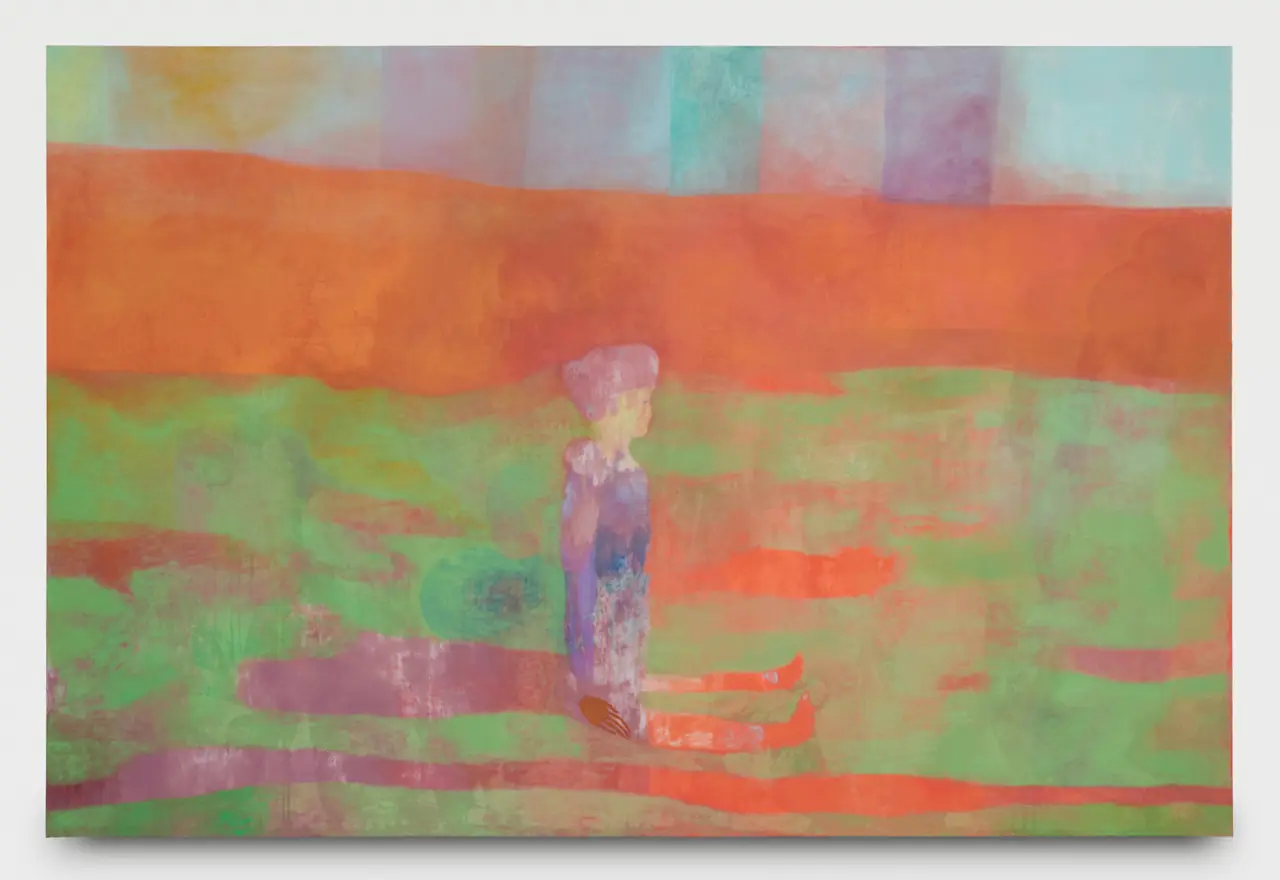
What from your completely ordinary life today finds its way into your paintings?
Your work is often discussed through large subjects — displacement, memory, mythology, spirituality, and trauma. But around all of those things, there is also everyday life: family, motherhood, the house, the desert, exhaustion, routine, cooking, driving somewhere, silence. How much do these seemingly insignificant things determine what you paint today? Is there an ordinary moment from the last few days that you already suspect might return to you in the studio?
I suppose I don’t make much of a distinction between what is extraordinary and what isn’t. Some of my favorite moments are small encounters with my daughter and noticing the tiny gaps between her baby teeth. It is a moment where I don’t feel like anything should be different. There seems to be a perfection right there in front of you. A similar feeling, I can find in a particular note in a song or in the smell of moist soil on a hike that takes me back to 1989 and a particular pair of red rubber boots. Silence and attention, deep attention is akin to prayer according to Simone Weil.
I find much of the world to sound like grating Styrofoam. I observe this in group dynamics. No one is really listening; everyone and everything is loud. Are we all neglected children seeking attention? If this is a collective complex, it is one that capitalist-consumerist culture exploits heavily. Social media has made us all into shivering chihuahuas. I know I often feel like one, and I’m always feeling my way towards the Archetypal Mother, the only true medicine for our collective malaise. Can everyone please read Byung-Chul Han and to quote David Lynch “Fix your heart or die!”.
Painting is a place for me where I can be quiet and find pleasure in not knowing, something I trust deeply. There is a kind of rapture that can be cultivated only from the practice of sitting still with not knowing. Hypomonē is an ancient Greek word I learned recently, while reading Simone Weil’s ‘Waiting for God’. Hypo meaning under or beneath and meno meaning to abide or to stay; it describes a kind of spiritual stamina. That’s the gift I want to give people with my art: the stamina, as well as a place to endure their fear of that enormous, dark, delicious silence. Beauty makes it easier to stay with trouble, which is why I believe that art is a radical form of spiritual resistance.
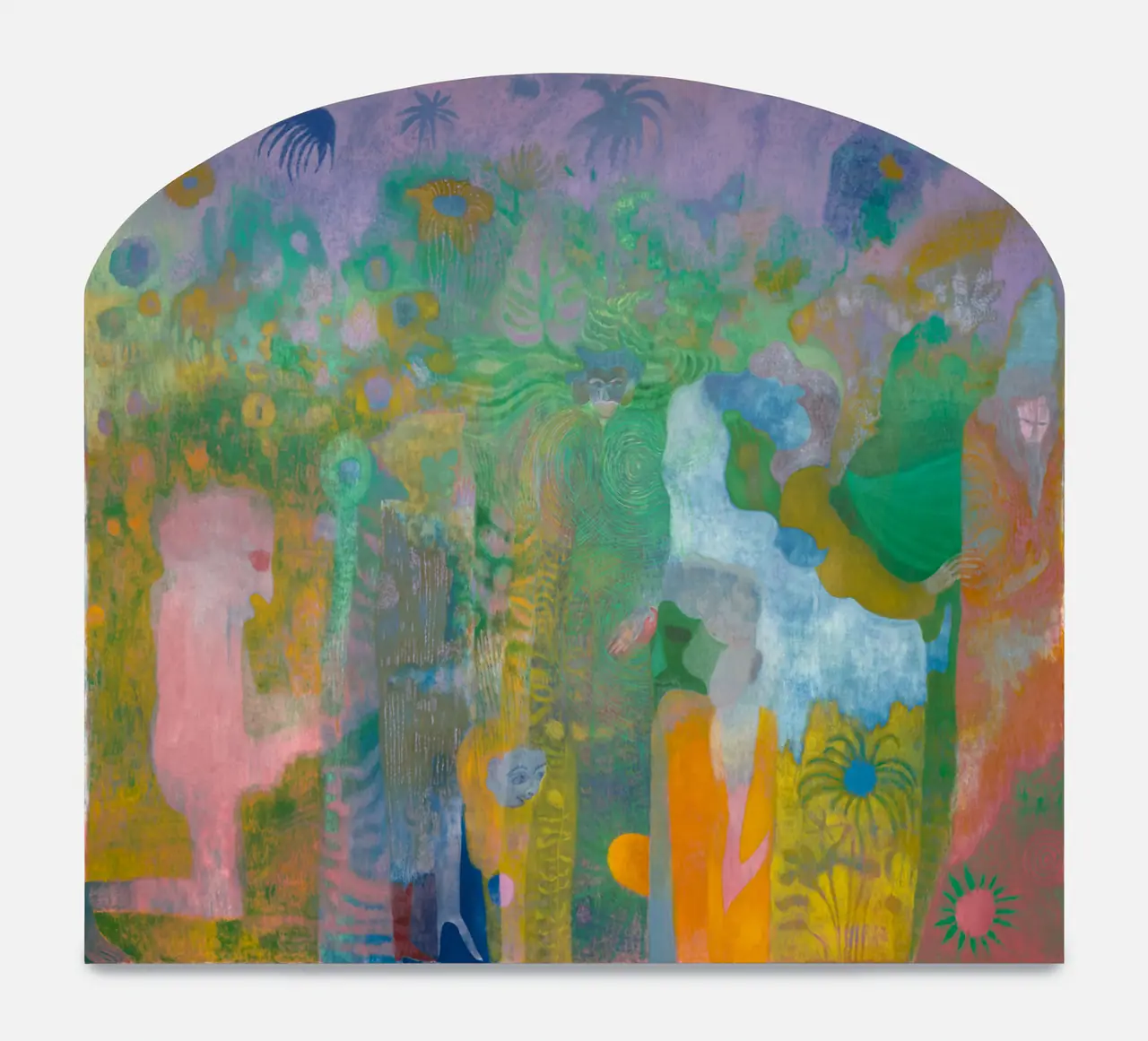
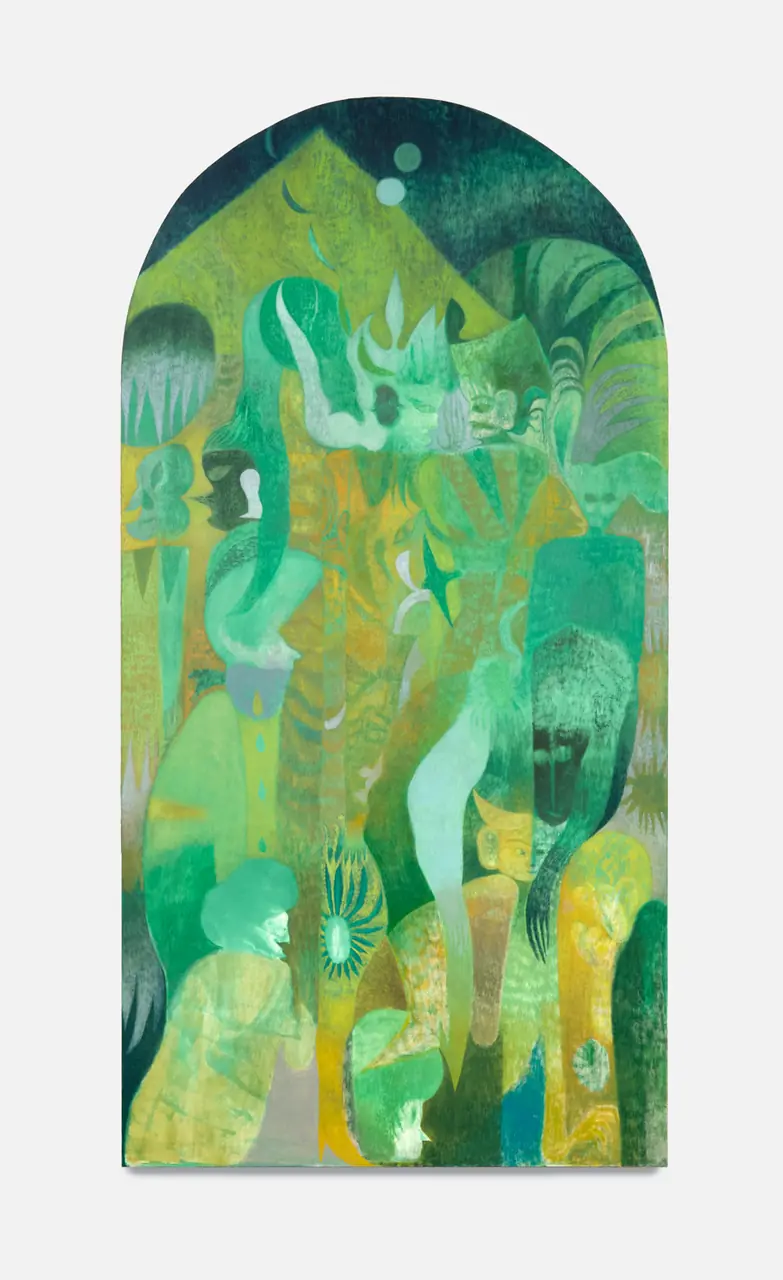
You have spoken about listening to a painting and allowing it to tell you what it needs. What happens when you don’t trust it?
Your paintings often begin without a predetermined destination — through colour, stains, looking, and waiting, until something begins to reveal itself. We live in a moment that constantly asks us to explain what we are doing, why we are doing it, and what the outcome will be. How important is it for you to protect a space in which you simply do not know? Has painting become one of the places where you still allow yourself not to have an answer?
Well, I always trust the process of making a painting. I don’t trust myself, is the thing. I know that’s a funny thing to say, and maybe it doesn’t make sense, but I trust that the painters reading this will know what I mean. To fully surrender means to let go of desired outcomes and to abandon that which already exists. We’re going for a new thing here, and so, into the unknown. That’s also why I don’t do sketches or look at reference material.
Letting go comes easily to me when it comes to painting, not so much in life. I wish! When painting, I flip the canvas around constantly, seeking to destabilize my senses, any sort of orientation or direction. I find that completely thrilling and fun. I try not to know anything about the painting until the very end, and even then, I hope only for intimations to arise. Painting allows me to enter into a time without time where everything feels suspended — a land of myth. In this suspended realm, everything feels timeless, bigger than me and bigger than the moment we are living in. Nothing in it is of this world. This suspended world has no sound, only impressions and the phenomena in it, is mercurial, and has a holographic quality. Nothing is of solid matter, but rather, etheric.
“Art is a radical form of spiritual resistance.”— Maja Ružnić
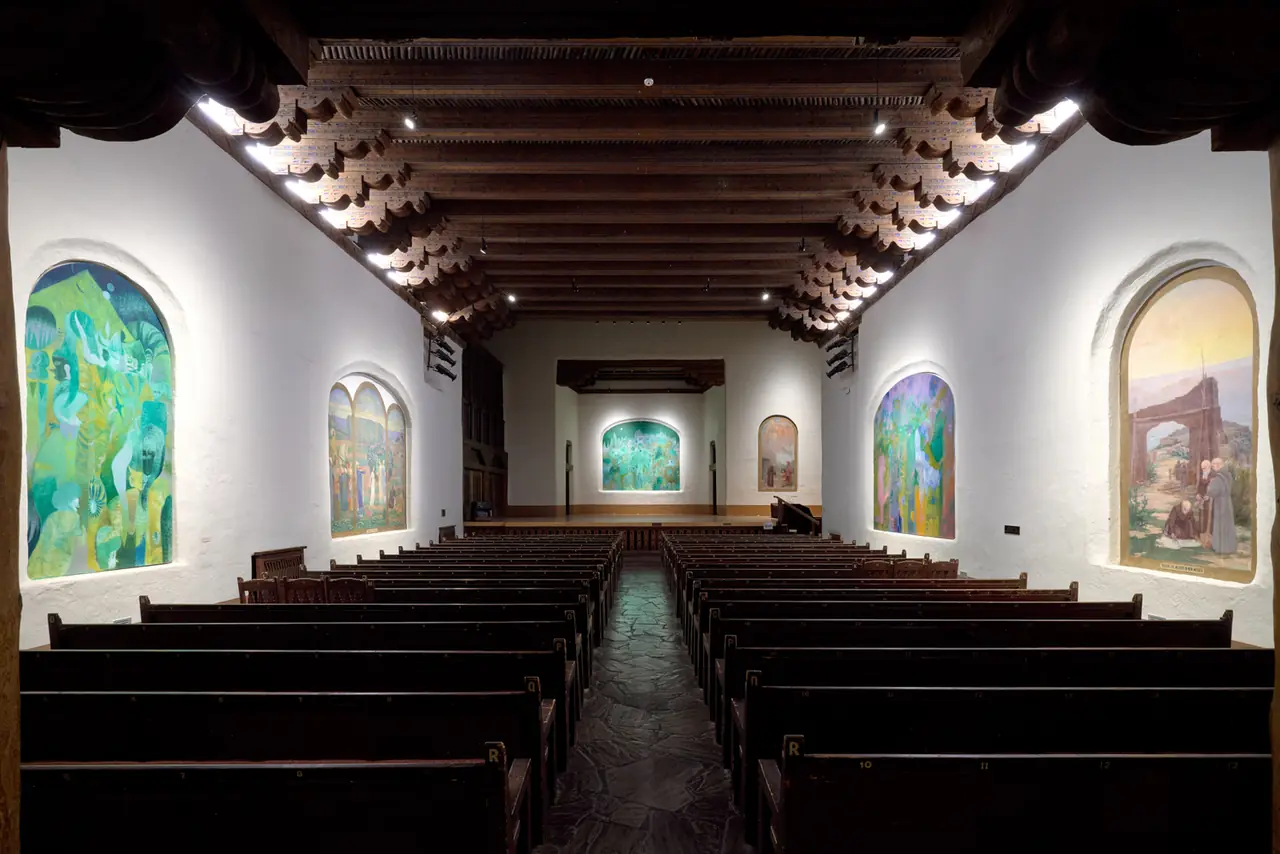
If you could preserve only one completely ordinary image of your life as it is today — what would be in that image?
Not a work of art, simply a scene you could return to twenty years from now.
The feeling of Mila falling asleep next to me. The smell of her sweaty hair, her tiny hand clasped in mine. Her belly rising and falling.